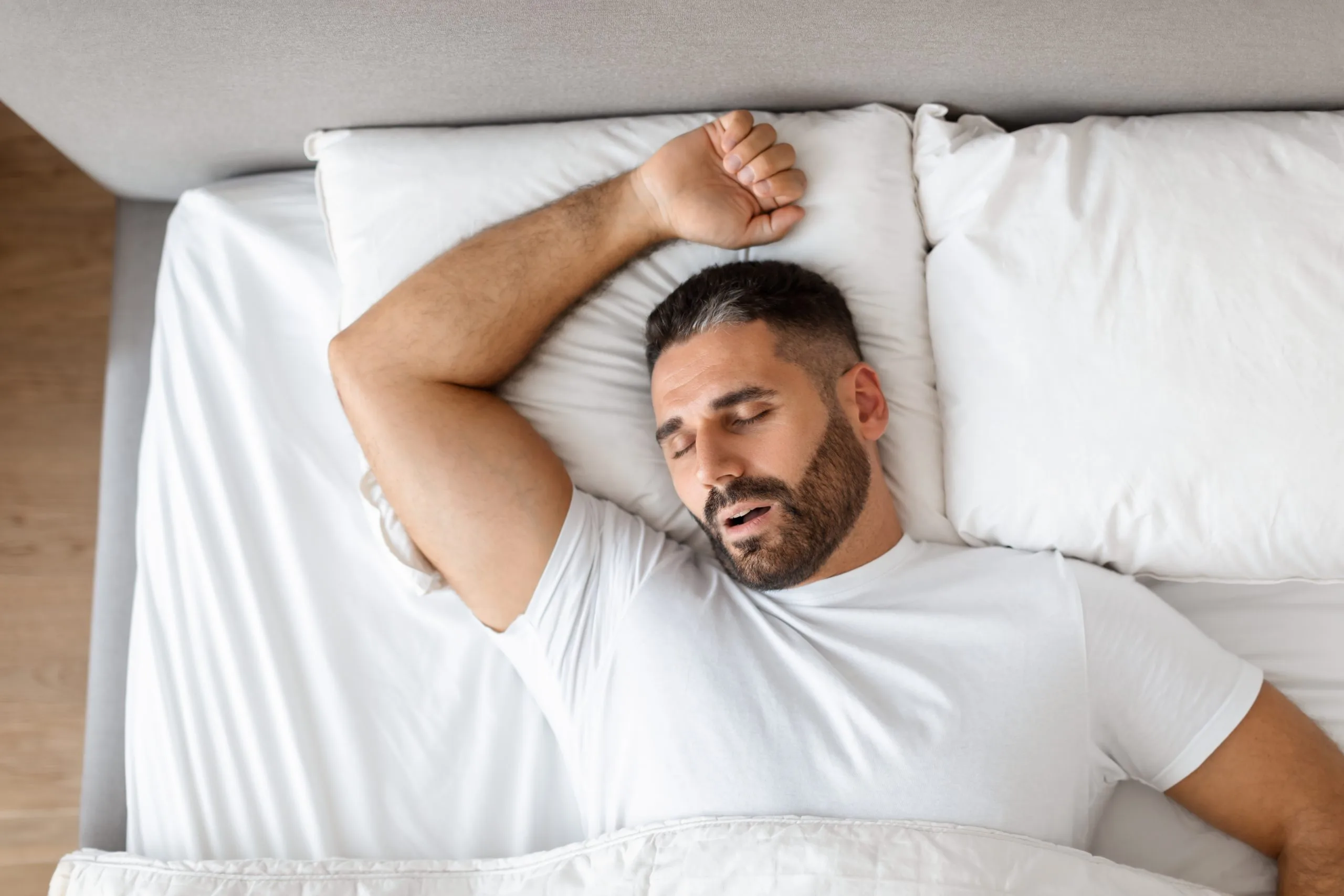
Yes – there is a well-established, bidirectional link between sleep apnea and low testosterone. Each condition can cause or worsen the other. When breathing stops and starts through the night, the body produces less testosterone. When testosterone drops, sleep quality often worsens, weight can increase, and the airway can become even more unstable.
For many middle-aged men along the Gulf Coast, this is not two separate problems. It is one loop. Fatigue, mood changes, and weight gain attributed to one issue may actually be driven by both. At ISS Gulfcoast, we specialize in identifying the root causes of sleep disorders. Untangling this connection is the first step toward restoring energy, health, and overall well-being.
Sleep apnea is a disorder in which breathing repeatedly stops or becomes very shallow during sleep. The most common form is obstructive sleep apnea (OSA). In OSA, the muscles in the back of the throat relax too much. Soft tissue then collapses inward, blocking the upper airway.
The brain senses the drop in oxygen and briefly wakes the person – often without a full memory of the event – so that breathing can resume. These pauses can last 10 seconds or longer and can happen dozens or even hundreds of times in one night, preventing deep, restorative sleep.
Obstructive sleep apnea is not the same as simple snoring. Snoring can exist without apnea. Apnea means airflow is reduced or cut off. That drop in airflow stresses the heart, fragments sleep, and disrupts hormones.
Common signs of sleep apnea include:
Loud, persistent snoring
Witnessed episodes of gasping, choking, or stopped breathing during sleep
Waking up with a dry mouth or sore throat
Morning headaches
Excessive daytime sleepiness, or hypersomnia, and unplanned naps even after a full night in bed
Difficulty concentrating and memory problems
Irritability, depression, or mood swings
Unrestful sleep even after a full night in bed
If you snore, feel tired during the day, or stop breathing in your sleep, those three concerns matter. They are the same questions that bring many men in for evaluation.
Testosterone is a crucial hormone for men. It regulates libido, bone mass, fat distribution, muscle mass and strength, and the production of red blood cells. Its role in overall health is far more extensive than virility alone.
Testosterone is not made at a steady rate around the clock. Production is tied to the sleep-wake cycle, or circadian rhythm. Levels fluctuate throughout the day and peak in the early morning, depending on the previous night.
During sleep, the body cycles through light sleep, deep sleep, and REM (rapid eye movement) sleep:
A typical night includes several cycles, each lasting about 90 minutes
Testosterone production rises as the night goes on and climbs most during later cycles, when REM periods last longer
REM is when most dreaming occurs and when certain hormone signals are strongest
If those cycles stay intact, the morning testosterone level is usually at its daily high
If the cycles keep getting interrupted, that rise can stall
Sleep also supports other hormones that work with testosterone:
Growth hormone is released mainly in deep sleep
Cortisol, the stress hormone, should be lower at night and higher in the morning
Broken sleep can flatten or reverse these patterns
Age plays a role as well. Testosterone tends to decline slowly after the 30s. That natural drop is not the same as a sharp fall caused by untreated apnea. When a middle-aged man already has a gradual decline and then develops sleep apnea, the two trends can stack. The lab result looks worse than age alone would explain.
The scientific and medical communities have established a clear and significant connection. Studies in men with obstructive sleep apnea have found lower testosterone levels than in men of similar age who breathe normally at night. The more severe the apnea, the more likely a drop in hormones.
Sleep apnea is a primary cause of secondary hypogonadism – low testosterone not caused by a problem with the testes themselves. Sleep specialists and endocrinologists now routinely consider the presence of one condition when diagnosing the other. The link runs in both directions. Treating only one side often leaves the other unresolved.
Every time breathing stops, several things happen at once. Oxygen in the blood falls. Carbon dioxide rises. The nervous system fires a stress response. Sleep stage shifts. Heart rate and blood pressure jump. None of these events is friendly to hormone production.
Over a single night, those events add up. Over months and years, they can change the baseline testosterone level.
Testosterone production peaks during REM sleep. In obstructive sleep apnea, airway collapse is often worse during REM because muscle tone in the throat is already lower in that stage. Extra tissue or extra weight makes the airway even more likely to close.
The constant arousals caused by breathing interruptions prevent you from entering and sustaining deep REM and slow-wave sleep:
The brain pulls the person out of REM to restore breathing
Those arousals chop REM into fragments
The long, late-night REM periods that should support the morning testosterone peak never fully form
Men with untreated apnea often spend less total time in REM and less time in deep sleep
Morning blood work can then show a lower total testosterone, a lower free testosterone, or both. You might be in bed for eight hours, but time in bed is not the same as time in the stages that build hormones.
Each apnea event causes a drop in blood oxygen levels, a condition called intermittent hypoxia. Repeated hypoxia is a major physiological stressor. It triggers the release of cortisol and other stress chemicals, which can further interfere with testosterone production.
The pathway is the hypothalamic-pituitary-gonadal axis. In plain language: the brain talks to a small gland, and that gland talks to the testes. Low oxygen and high stress can muffle that conversation. The testes then make less hormone even if they are otherwise healthy.
The effects of sleep apnea on testosterone are not the result of one or two bad nights. It is a cumulative process. Night after night of micro-awakenings keeps the brain in a lighter, more defensive mode. Deep sleep and REM never stabilize.
Long-term effects can include:
Persistently lower morning testosterone
Higher inflammatory markers
Greater abdominal fat
Reduced muscle mass
Higher blood pressure
Greater daytime sleepiness, sometimes severe enough to look like hypersomnia
Sleep fragmentation is not the same as insomnia, though the two can overlap. Insomnia is trouble falling or staying asleep. Fragmentation from apnea can happen even when the person falls asleep quickly. He may not remember the arousals. He only knows he is exhausted.
Middle-aged men are the group most often caught in this pattern. They are also the group most likely to have both excess neck fat and a gradual age-related decline in hormones. Untreated apnea accelerates the decline. Many men who come to our Biloxi clinic complaining of profound fatigue and low energy are surprised to learn that the root cause lies in how they breathe – or don’t breathe – at night.
Testosterone supports muscle mass, including the muscles that help keep the airway open. It also influences fat distribution. When hormone levels fall, the body tends to store more fat in the abdomen and around the neck. Both changes raise the odds of airway collapse.
One of the most significant effects of low testosterone is its impact on body composition. Muscle is metabolically active. Fat is not. As testosterone drops, muscle can shrink, and fat can increase, even if eating habits have not changed much. Hunger can increase. Energy for exercise can fall. The scale moves in the wrong direction, and apnea severity often follows.
The crushing fatigue associated with low testosterone makes a regular exercise routine feel like an insurmountable task. Men nap during the day. They sit more. Deconditioning follows.
Physical activity helps sleep in several ways:
It supports a healthier body weight
It can increase deep sleep
It improves insulin sensitivity
It helps maintain the muscle that supports posture and airway control, including the pharyngeal muscles that keep the airway open at night
When activity drops, those benefits fade.
Here is how the cycle typically plays out:
A person (often a middle-aged man) develops or has worsening sleep apnea, perhaps due to age or weight gain. Airway collapse at night fragments sleep and reduces oxygen levels.
The nightly apneas, oxygen drops, and sleep fragmentation suppress testosterone levels and raise stress hormone levels.
Lower testosterone and poor sleep promote fat gain (especially belly fat), muscle loss, lost motivation for exercise, and a drop in libido.
Extra fat – particularly around the neck – and weaker airway muscles physically narrow the airway, making collapse more likely.
The now-worse sleep apnea leads to even more severe sleep fragmentation and oxygen deprivation, driving testosterone levels even lower.
The loop repeats, with each condition feeding the other, leading to a progressive decline in both sleep quality and hormonal health.
Given the symptoms, many men might think the simple solution is to start Testosterone Replacement Therapy (TRT). TRT can help with energy, mood, muscle function, and sexual function when it is truly indicated. However, it is not a sleep treatment.
In some men, it can make obstructive sleep apnea worse. That is why the two conditions should be considered together, not in isolation. Starting TRT can be ineffective and even dangerous if an underlying sleep disorder is not addressed first.
You do not need to wait until symptoms are extreme. The earlier the airway is evaluated, the less time the hormone loop has to tighten. If you’re a man experiencing a combination of the symptoms discussed, it’s time to consider a professional evaluation.
Consider a sleep evaluation if several of these apply:
Your partner complains about your loud snoring, or someone has seen you stop breathing, gasp, or choke in your sleep
You wake up feeling just as tired as when you went to bed, or unrefreshed after what should have been enough hours
You are tired during the day, fall asleep when you do not mean to, or rely on caffeine to get through the day
You’ve gained weight around your midsection that is difficult to lose, and you’ve lost muscle
Your motivation and energy levels have plummeted
Your mood is more irritable or flatter than it used to be
Your interest in sex has noticeably decreased, or erectile function has declined
You struggle with focus and feel like you’re in a constant “brain fog”
Morning headaches or dry mouth are common
Blood pressure is harder to control
Any one sign can have more than one cause. A cluster of them – especially snoring plus sleepiness plus low energy or low testosterone – is a reason to look at the night in detail.
Sleep apnea and low testosterone are linked, and each can make the other worse. Unstable breathing at night disrupts REM sleep, lowers oxygen levels, and suppresses hormone production. Low testosterone then encourages fat gain, weaker airway muscles, and poorer sleep.
The way out of that loop is not guesswork. Effective treatment for sleep apnea doesn’t just improve your sleep – it can directly address one of the primary drivers of low testosterone. By restoring normal breathing and allowing for deep, restorative sleep, you give your body the chance to heal and reset its natural hormonal balance.
If you are struggling with symptoms, the first and most crucial step is a professional sleep evaluation. When sleep is restored, energy, mood, and testosterone often move in the same direction. Breaking the cycle starts with a good night’s sleep.

About the Author
Vincent Pisciotta, M.D., F.A.C.S
September 18, 2026
