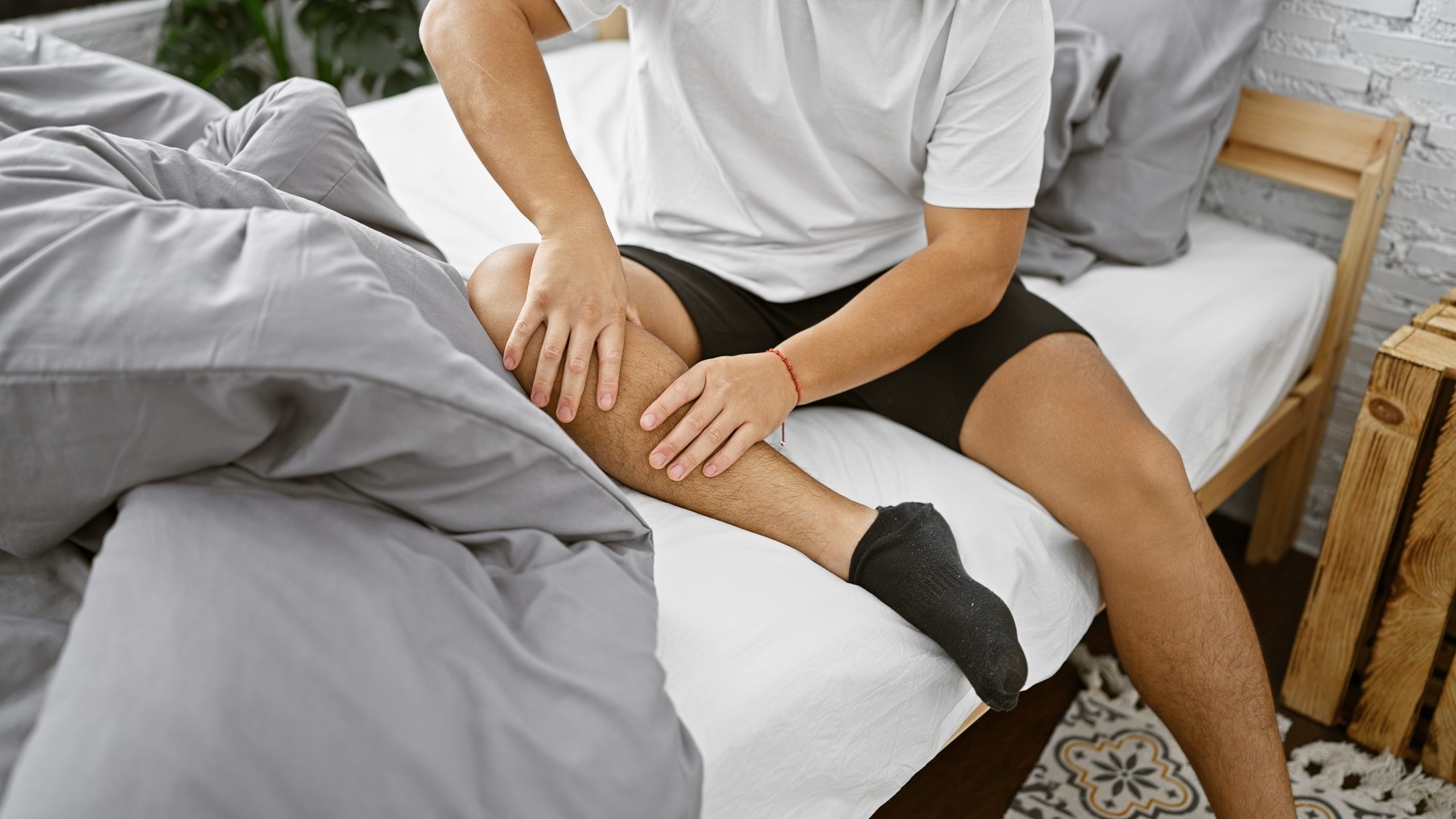
Restless Leg Syndrome (RLS) feels like an overwhelming, hard-to-ignore urge to move your legs, often accompanied by strange sensations deep within your limbs. These aren’t simple muscle aches – they’re often described as crawling, creeping, pulling, tingling, or itching, and they create an irresistible need to get up and move. This neurological sleep disorder occurs mainly during rest or inactivity, especially at night, making it a significant cause of sleep disruption. If you’ve ever felt like your legs simply “won’t be still” when you try to relax, you may be experiencing this common condition.
At ISS Gulfcoast in Biloxi, MS, we help patients across the Gulf Coast understand these unusual sensations and find real solutions for both comfort and sleep quality.
RLS is a nervous system condition that affects how your legs feel and behave, especially during rest. Unlike a leg cramp that strikes suddenly, RLS is a more persistent, creeping issue that builds when you try to relax.
RLS sensations are internal – felt deep within the leg, usually in the calves between the knee and ankle, but sometimes in the thighs or feet – rather than on the skin’s surface. They’re almost always uncomfortable rather than painful. Common descriptions include:
A creepy-crawly or “heebie-jeebies” feeling under the skin
Itching, pulling, or tugging deep inside the muscle
Tingling, or “pins and needles”
A sensation like soda water bubbling under the skin
An electric, jittery, or jumpy feeling
A vague ache or throbbing that compels movement
These feelings can occur in one or both legs and, in some cases, may affect the arms, chest, or head.
The defining characteristic of RLS is the intense, semi-voluntary urge to move the affected limbs. This isn’t a voluntary fidget – it’s a response to deep-seated discomfort that makes sitting still for long periods feel like torture, whether in a movie theater, on a long car ride, or at a desk.
Relief from movement – walking, stretching, or jiggling the legs – is immediate but temporary. The moment you sit or lie down again, the sensations and the urge return, creating a frustrating cycle.
RLS follows a distinct circadian pattern: symptoms are typically mild or absent in the morning, then intensify as the day goes on, peaking in the evening and at night just as you’re trying to wind down.
This nighttime worsening is what classifies RLS as a true sleep disorder. The constant need to move can make it nearly impossible to fall asleep, leading to significant insomnia. Even after falling asleep, the sensations or involuntary leg movements (Periodic Limb Movements of Sleep) can cause repeated awakenings, resulting in fragmented, unrestful sleep.
Because the symptoms are so unusual, hearing how other patients describe them can be validating and help you determine if what you’re experiencing might be RLS.
Patients often use vivid, creative language to capture the experience:
“My legs have a life of their own at night.”
“It feels like bugs are crawling under my skin.”
“I have to get up and pace the floors just to get a minute of peace.”
“There’s a jittery, restless energy I can’t shake.”
“It’s like soda fizzing inside my legs.”
“I have to stretch or kick to make it stop.”
If you relate to these descriptions, you are not alone. Many people feel they simply cannot get comfortable, no matter how they position their legs.
It’s crucial to distinguish RLS from other common leg complaints, such as nighttime muscle cramps (a “charley horse”).
Cause of Sensation: A cramp is a painful, involuntary tightening of a muscle you can often feel and see. RLS sensations aren’t a muscle contraction – they’re neurological signals that create an urge to move.
Relief: With a cramp, stretching forces a contracted muscle to relax; moving a cramped muscle can even hurt more. With RLS, any movement – walking, jiggling, rubbing – brings temporary relief.
Timing: A cramp strikes suddenly and lasts seconds to minutes. RLS builds during rest, is strongly tied to nighttime, and can persist for hours if unmanaged.
Knowing the difference helps you and your care team pinpoint what’s really going on.
While the name emphasizes the legs, RLS sensations aren’t always confined there. In some people, the same restless feelings can spread to the arms, torso, or even the face – typically as the condition progresses – following the same pattern of worsening with rest and improving with movement.
Many people with RLS also have a related condition called Periodic Limb Movements of Sleep (PLMS) – involuntary, repetitive jerking or twitching of the limbs during sleep. You may be unaware of these movements, but a bed partner often notices them first. PLMS can further fragment sleep and contribute to daytime fatigue. An overnight diagnostic sleep study is one of the primary tools used to identify it.
RLS is more than a minor annoyance. When left unmanaged, its effects can ripple through every aspect of your health and well-being.
Because symptoms peak at night, the most immediate consequence is a devastating effect on sleep. The urge to move makes it hard to fall asleep (sleep-onset insomnia), while frequent awakenings cause sleep-maintenance insomnia. Over time, this becomes chronic insomnia – and it’s often what finally pushes people to seek help, not the leg sensations themselves.
A night battling restless legs leads to a day of exhaustion – you feel drained no matter how much time you spend in bed. This chronic sleep loss can cause significant daytime sleepiness, sometimes diagnosed as hypersomnia, and impairs cognitive function, leading to:
Difficulty concentrating
Memory problems and slower thinking
Reduced productivity at work or school
Irritability and mood swings
A general feeling of being “in a fog”
For many, this impact on alertness and mental clarity is what finally prompts a professional evaluation.
Living with a chronic condition that robs you of restorative sleep takes a significant emotional toll. Ongoing sleep loss is linked to anxiety, low mood, stress, and even depression, as evenings become a source of dread rather than relaxation.
Many people also feel isolated because their symptoms are so hard to explain. Recognizing that these emotional effects are a real part of the condition – not something to simply push through – is critical for your overall health.
At ISS Gulfcoast, the diagnostic process is managed personally by our board-certified specialist, Dr. Vincent Pisciotta. The journey begins with a comprehensive, in-person consultation at our Biloxi office, where Dr. Pisciotta listens carefully as you describe your symptoms, reviews your medical history, and discusses your sleep patterns. We serve patients throughout the Gulf Coast, including those willing to travel up to an hour for expert sleep care.
From there, Dr. Pisciotta determines the most appropriate testing for your situation. This may include:
A convenient home sleep study
A detailed overnight sleep study capturing brain waves, breathing, and limb movements
Actigraphy, which tracks rest/activity cycles
These tests help paint a full picture of how RLS and any related conditions, such as sleep apnea, are affecting your rest. You can also explore the full range of conditions we treat. At a follow-up appointment, Dr. Pisciotta reviews the results and works with you to build a personalized plan to manage your Restless Leg Syndrome and restore restful sleep.
Restless Leg Syndrome is far more than fidgeting – it’s a complex neurological disorder characterized by an uncomfortable, irresistible urge to move the legs, often accompanied by creeping, pulling, tingling, or aching sensations that worsen at rest and at night. Unlike ordinary muscle cramps, these feelings improve with movement. Left unchecked, RLS can disrupt your sleep, drain your energy, and affect your mood and focus. Recognizing these symptoms is the first step toward finding relief and better sleep.

About the Author
Vincent Pisciotta, M.D., F.A.C.S
July 15, 2026
